Showing posts with label Pakistan. Show all posts
Showing posts with label Pakistan. Show all posts
Friday, 26 August 2011
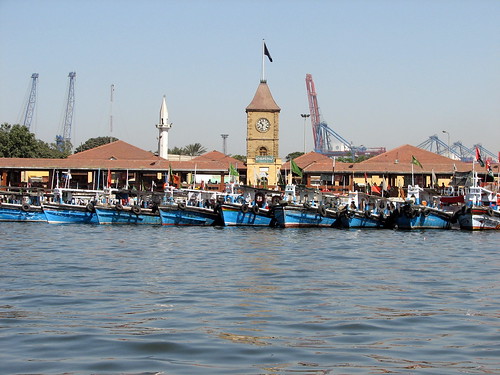
Karachi boat harhour, Pakistan

Badshahi Mosque Lahore, Pakistan

Able to host 5000 praying that the main prayer hall, and in addition to 95 000 in the hotel courtyard and arcades, was the largest mosque in the world from 1673 to 1986 (more than 313 years), exceeded in size by the end Faisal Mosque in Islamabad. Today, it is still the second largest mosque in Pakistan and South Asia and the fifth largest mosque in the world after the Masjid al-Haram (Grand Mosque) in Mecca, al-Masjid al-Nabawi (Prophet's Mosque) in Medina, the Hassan II Mosque in Casablanca and Faisal Mosque in Islamabad.
To appreciate its size, the four minarets of Badshahi Mosque is 13.9 feet (4.2 m) larger than the Taj Mahal and the main platform of the Taj Mahal can be embedded within the FT 278 784 m (25899.9 m 2) of the Badshahi Mosque court, the court is the world's largest mosque.
In 1993, the Government of Pakistan has recommended the inclusion of Badshahi Mosque, as a World Heritage site of UNESCO World Heritage List, where it is incorporated in Pakistan in a preliminary list of the possible designation of the World Heritage List of UNESCO.
Silver Temple Amritsar, Pakistan

a symbol of the Sikh faithful aim to live a pure life, natural life.
Causeway, gurus, "Bridge leads to two-story marble temple Hari Mandir Sahib or Darbar Sahib temple is located in the center of the sacred pool Amrit Sarovar -. Nectar the pool, which gave the town its name.
Sikhism was founded by Guru Nanak in the 15th century. However, I believe that was founded by
their pupils / students aged Nanak not really want to establish a new religion -
He was against the rule and the Brahmin caste of the ritual.
He prayed for both temples and mosques, worshiping God in his music, traveling a lot, except in India. He kept saying that "God is living a few places, because God is where ever, and for all."
Sikhs believe in one God, and although they refuse to worship idols (you will not see pictures or statues in their gurudwara / time), others taking pictures of the 10 gurus as the focal point
Mountains of Kashmir, Pakistan

In the first half of the first millennium, Kashmir, a major center of Hinduism and Buddhism later, still later, in the ninth century, Kashmir Shaivism arose. In 1349, Shah Mir was the first Muslim ruler of Kashmir and inaugurated the Salatin-i-Kashmir Swati dynasty. So Chak dynasty and their successors have exercised power and influence, until his defeat by the Mughals, by fraud in 1586 AD. In the coming centuries ruled Kashmir Muslim monarchs, including the Mughals, who ruled from 1586 until 1751, when the Durrani Afghan empire that ruled from 1747 until the 1820th This year, the Sikhs under Ranjit Singh, annexed Kashmir, but it was useless because they have never ruled the country altogether. In 1846, following the acquisition of the region of the British under the Treaty of Amritsar in Dogras under Gulab Singh, became the new power. Dogra rule in the balance (or guardian) of the British Crown, lasted until 1947, when the former princely state became a disputed territory, now administered by three countries: India, Pakistan and China.
Subscribe to:
Posts (Atom)