Showing posts with label China. Show all posts

Tuesday, 23 August 2011

Sunset over the Great Wall of China

The museum photographer went to China to describe the Great Wall and the surrounding landscape, the Wall show much of China: dynasties, dragons and warriors. This is the vision of the watchtower in ruins, Jinshanling looking west at sunset. The photographer managed to capture only the sun was going down, a moment later, and this would not be missed. Our photographer spent a month traveling in China, our medium-format camera to change the landscape photography and the Great Wall of China. There have been many early morning starts in the sun, and traveling for hours through the desert to catch the sunset. Many of these pictures is the picture presented in a thrilling spectacle. We now have 3000 photos of this trip to the Photo Library.

Bronze Lion, Forbidden City, Beijing, China

Hines guardian lions, known as the lions Shishi (Chinese: , pinyin: Shishi, literally "stone lion") and the British lion guardian, often incorrectly called "Foo Dogs" in the West, are a common representation lions in the prairie -. Modern China have traditionally stood in front of the imperial palaces of China, the imperial tombs, government offices, temples and houses of government officials and the rich, the Han Dynasty (206 BC-220) and pairs are believed to have powerful effects mythical protectors. of guardian lions are still common decorative and symbolic elements at the entrances of restaurants, hotels, supermarkets and other structures, once on each side of the entrance, China and elsewhere in the world the Chinese have migrated and settled in particular neighborhoods in local Chinese market.

Shishi during the Ming Dynasty in Forbidden City

An era of Qing guardian lion couple in the Forbidden City. Note the different appearance of the face and the details of the decorative elements from the previous version of Ming

Lions are always created in pairs, the male keeps his foot resting on the world, and possession of a playful puppy who is on his back. They occur in many types of Chinese pottery and imitations of the West.

Terracotta Army

Terracotta Army (Simplified Chinese:, Traditional Chinese: Pinyin: bīngmǎ yǒng, "soldier and horse funerary statues" literally) or "Terra Cotta Warriors and Horses", is a collection of clay sculptures describes the armies of the Qin Shi Huang, first emperor of China. This is a form of funerary art buried in the Empire, 210-209 BC, and whose aim was to help guard his empire in his afterlife.

The figures, dating from the third century BC, were discovered in 1974 by local farmers in Lintong district, Xian, Shaanxi province, near the mausoleum of the First Qin Emperor (Chinese:, pinyin: Qin Ling Shǐhuáng).

The figures vary in height according to their functions, with the largest being the generals. The figures include warriors, chariots and horses. It is estimated that in the three pits containing the Terracotta Army there were over 8,000 soldiers, 130 chariots with 520 horses and 150 cavalry horses, the majority still buried in mass graves. Other cooked non-military figures have also been found in mass graves and include other officials, acrobats,

Pudong
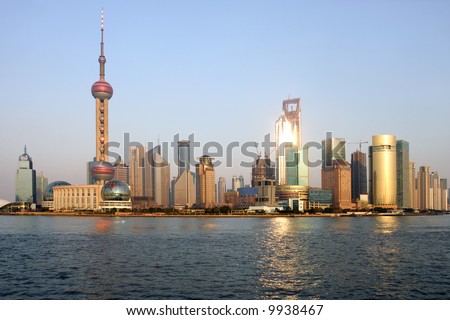
Pudong (simplified Chinese:, Traditional Chinese:), officially known as Pudong New Area (Simplified Chinese:, Traditional Chinese:, is a district of Shanghai, People's Republic of China with sub-provincial administrative status called "Pudong ". Due to its location on the east side of the Huangpu River, across from Puxi to the west. After its merger with May 2009 in Nanhui, Pudong New Area includes most of the land in the east of Shanghai.

Since the beginning of its development in 1990 when plans were first announced, Pudong has become a new open area of ​​economic development, and emerged as the economic and commercial center of China. Pudong is home to the Lujiazui Finance and Trade Zone, the Shanghai Stock Exchange, and a horizon that includes the symbolic Oriental Pearl Tower, Jin Mao, Shanghai World Financial Center and the Tower of Shanghai (under construction), reflecting in Shanghai and China's rapid economic development.