Kamakura (镰仓 市, Kamakura-shi?) Is a city located in Kanagawa, Japan, about 50 kilometers (31 miles) south-southwest of Tokyo. His name Renpu (镰 府?) (Abbreviation Kamakura Bakufu (镰仓 幕府 or Kamakura shogunate?)).
Although the right Kamakura is today a relatively small, is often described in history books as a former de facto capital of Japan as the seat and the Regency shogunate during the Kamakura period. Yet, despite the destruction of the Kamakura Kyoto-based political and military force in the battle of Dan-no-career in 1185, and the failure of the emperor to get rid of the controls during the Kamakura Jokyu War Takahashi (2005) has been challenged by Kamakura is a political hegemony at the national level, in fact, exist. Takahashi says that if you close the Kamakura Kanto, not only the emperor was in fact still the king of Kansai, but this time the city was in many ways politically and administratively, the ancient capital of Kyoto. Kamakura was simply competing center of political power, economic and cultural of the country, which was the capital of Kyoto.
According to the Institute for Research on world-systems, Kamakura was the fourth largest city in the world in 1250, with 200,000 people, the largest and Japan, eclipsing Kyoto 1200.
In a March 1, 2010, the city has an estimated population of 174,016 and a density of 4,390 inhabitants per square kilometer (11,400 / km ²). The total area is 39.60 km square (15.29 square miles).
Kamakura has been designated as a city on November 3, 1939.
Kamakura is a beach which, in combination with its temples and its proximity to Tokyo, making it a popular tourist destination. Kamakura has a bay out of the surf promontory point, though inconsistent, making it less a second-class destination for surfers. It is also known for its senbei, which are grilled crispy rice cakes and sold fresh along the main shopping street.
Showing posts with label Japan. Show all posts
Wednesday, 24 August 2011
Torii gates at Fushimi Inari Shrine, Kyoto, Japan
Fushimi Inari Taisha (?) Is the head shrine of Inari, located in Fushimi-ku, Kyoto, Japan. The sanctuary is situated at the foot of a mountain, also called Inari, and includes mountain roads to many smaller shrines.
Since the start in Japan, Inari is considered the patron of the company, each of the Torii was offered by a Japanese company. First, Inari is the god of rice.
Merchants and manufacturers of Inari worship of wealth. Don torii lining footpaths are part of the panoramic view.
This shrine is said people have as many as 32 000 sub-shrines (bunsh throughout Japan.
Since the start in Japan, Inari is considered the patron of the company, each of the Torii was offered by a Japanese company. First, Inari is the god of rice.
Merchants and manufacturers of Inari worship of wealth. Don torii lining footpaths are part of the panoramic view.
This shrine is said people have as many as 32 000 sub-shrines (bunsh throughout Japan.
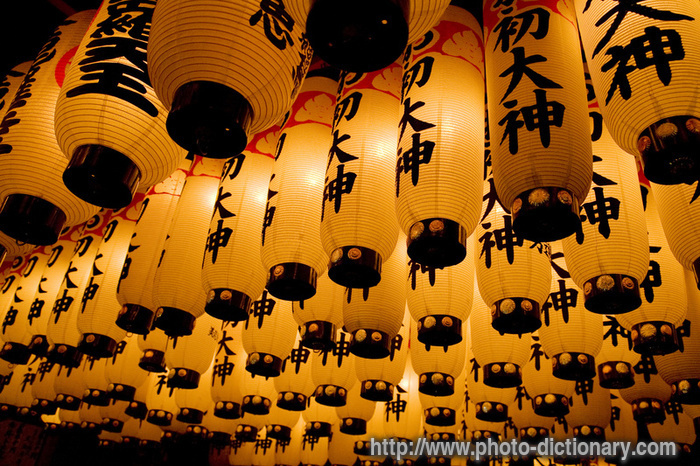
Japanese Lanterns
The Andon is a lamp made of paper stretched over a bamboo frame, wood or metal. The paper protected the flame from the wind. The burning of oil in a stone or ceramic support with a cotton wick, provided that light. Rapeseed oil has been popular. Candles were also used, but their high price made them less popular. A cheaper alternative is the sardine oil.
The Andon became popular in the Edo period. Andon was earlier this pocket, and it can also be placed on a stand or hung on a wall. It was the most common okiandon inside. Many had a box-shaped with a vertical inner surface of the light. Some had a drawer at the bottom for easy filling and lighting. A handle on top makes phones. A committee was Enshu Andon. An explanation which he attributed to Kobori Enshu, who lived in the late Azuchi-Momoyama period and early Edo period. Tubular in shape, he had an opening instead of a drawer. Other black, was the Ariake Andon, a bedside lamp. Kakeandon the attic of a store that is often called the merchant, was a common sight in cities.
The term Andon Hiru, or "day of fire" means someone or something that seemed to serve no purpose. Dramatize the story of the forty-seven ronin, Oishi Yoshio is often given this description.
The Andon became popular in the Edo period. Andon was earlier this pocket, and it can also be placed on a stand or hung on a wall. It was the most common okiandon inside. Many had a box-shaped with a vertical inner surface of the light. Some had a drawer at the bottom for easy filling and lighting. A handle on top makes phones. A committee was Enshu Andon. An explanation which he attributed to Kobori Enshu, who lived in the late Azuchi-Momoyama period and early Edo period. Tubular in shape, he had an opening instead of a drawer. Other black, was the Ariake Andon, a bedside lamp. Kakeandon the attic of a store that is often called the merchant, was a common sight in cities.
The term Andon Hiru, or "day of fire" means someone or something that seemed to serve no purpose. Dramatize the story of the forty-seven ronin, Oishi Yoshio is often given this description.
Subscribe to:
Posts (Atom)