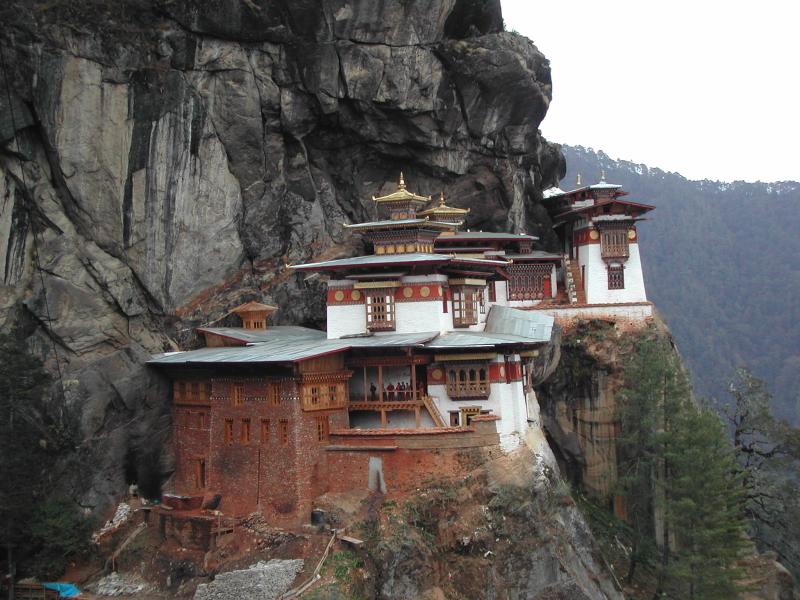
Taktsang Paro (spa phro degree tshan / spa gro stag tshan), is a popular name Palphug Taktsang Monastery (also known as Tiger's Nest, visible Himalayan Buddhist shrine and temple complex, which is in cliffside above Paro Valley, Bhutan. The temple complex was built in 1692, about Taktsang Samdup Senge (degree tshan Seng GE bSam grub) cave where Guru Padmasambhava is said to meditate three months in the 8 th century. Padmasambhava is credited with ' introduction of Buddhism in Bhutan and the tutelary deity of the country. Today, Paros is the best known of Taktsang Taktsang thirteen or "Tiger's Lair" caves where he meditated.
Guru-mtshan brgyad Lhakhang, the temple dedicated to Padmasambhava (also known as Gu-ru-mtshan brgyad Lhakhang, "The Temple of the Guru with Eight Names") is an elegant structure, built around the cave in 1692 by Tenzin Gyalse Rabgye and became the icon of the culture of Bhutan. A popular festival, known as Tsechu, held in honor of Padmasambhava, is celebrated in the valley of Paro in the course of March or April.
Showing posts with label Bhutan. Show all posts
Tuesday, 23 August 2011
Bhutanese prayer flags
For centuries, prayer flags were part of the tradition of Bhutanese people that symbolizes the reality and extent of their faith.
Usually, Bhutan, prayer flags are hoisted for happiness, long life, prosperity, luck and karmic merit and provide credit to all sentient beings. After death, the benefits of the offer of prayer flags to guide the souls of the dead out of hell and to prevent his rebirth in the three lower realms (ESN song Sum, animals and ready-to-life hell) six cycles of life: lha (god), Lha Min (Demi God), humans, animals, smart, and life in hell, according to a Buddhist scholar, Dasho Lam Sanga.
Prayer flags are raised outside the house, hung on bridges, hills, and places of spiritual significance. According to researchers, there are generally three types of prayer flags printed: Lungdhar or Chudhar, and Mani Lhadhar or Baza Guru Dhar, who are registered with auspicious symbols, calls, prayers, the NGA (mantras), print protectors of Buddhism and enlightened beings.
"Basically, prayer flags to bring good luck and merit to all sentient beings, not just the person who raises flags," said Dasho Lam Sanga. "But if you look at the deeper aspect, each prayer flag itself a world of meaning. "
"Wind Horse" or Lungdhar Lung Ta, meaning and CHUD (flags water bodies) are high or hung on the advice of an astrologer to dispel misfortune, or the beginning of a long journey, and more recently in launching a new business. Prayer flags must be hoisted on the date and time of birth or attract the obstacles, as long as the prayer flags last.
Lhadhar is also a form of Lungdhar, but is much taller and bigger. Normally, a Gyeltshen (victory sign) plugs at the top.
The Lhadhar, according to Lam Kezang Chopel Trashiyangtse Rigney School was raised as a landmark near dzongs and Lhakhang. "When you see this flag is a sign that nearly or Lhakhang Dzong. It is a sign for you to be formally prepared," he said.
Gyeltshen Tsemo mantras are printed on the Lhadhar. That was also raised by dzongpons and the rich and powerful families in the past to achieve success in their business and to ward off bad luck and obstacles in life.
Usually, Bhutan, prayer flags are hoisted for happiness, long life, prosperity, luck and karmic merit and provide credit to all sentient beings. After death, the benefits of the offer of prayer flags to guide the souls of the dead out of hell and to prevent his rebirth in the three lower realms (ESN song Sum, animals and ready-to-life hell) six cycles of life: lha (god), Lha Min (Demi God), humans, animals, smart, and life in hell, according to a Buddhist scholar, Dasho Lam Sanga.
Prayer flags are raised outside the house, hung on bridges, hills, and places of spiritual significance. According to researchers, there are generally three types of prayer flags printed: Lungdhar or Chudhar, and Mani Lhadhar or Baza Guru Dhar, who are registered with auspicious symbols, calls, prayers, the NGA (mantras), print protectors of Buddhism and enlightened beings.
"Basically, prayer flags to bring good luck and merit to all sentient beings, not just the person who raises flags," said Dasho Lam Sanga. "But if you look at the deeper aspect, each prayer flag itself a world of meaning. "
"Wind Horse" or Lungdhar Lung Ta, meaning and CHUD (flags water bodies) are high or hung on the advice of an astrologer to dispel misfortune, or the beginning of a long journey, and more recently in launching a new business. Prayer flags must be hoisted on the date and time of birth or attract the obstacles, as long as the prayer flags last.
Lhadhar is also a form of Lungdhar, but is much taller and bigger. Normally, a Gyeltshen (victory sign) plugs at the top.
The Lhadhar, according to Lam Kezang Chopel Trashiyangtse Rigney School was raised as a landmark near dzongs and Lhakhang. "When you see this flag is a sign that nearly or Lhakhang Dzong. It is a sign for you to be formally prepared," he said.
Gyeltshen Tsemo mantras are printed on the Lhadhar. That was also raised by dzongpons and the rich and powerful families in the past to achieve success in their business and to ward off bad luck and obstacles in life.
Paro Taktsang
Rate Song Paro (spa PHRO deer tshang / spa gro stag tshang) is the rate the song popular name Palphug Monastery (also known as Tiger's Nest), a leading Himalayan Buddhist shrine and temple complex, located in the side of Mount the top of Paro Valley, Bhutan. A temple complex was built in 1692, on the stroke Blood Beds Samdup (deer tshang Seng GE bsam grub) cave where Padmasambhava meditated for three months would be in the 8th century. Padmasambhava is credited with the introduction of Buddhism in Bhutan and the tutelary deity of the country. Rate Song Today Paro is the best known of the thirteen that the song or the "den of the Tiger", the caves where he meditated.
Mtshan-brgyad Guru Lhakhang, a temple dedicated to Padmasambhava (also known as Gu-ru-mtshan brgyad Lhakhang, the "Temple of the eight names Guru") is an elegant structure of the cave in 1692 by Tenzin gyals Rabgye, and is become a popular cultural icon Bhutan.A festival, which is known Tsechu, in honor of Padmasambhava, is celebrated in Paro valley, sometimes in March or April.
Subscribe to:
Posts (Atom)